
I Got It From My MommaThe Inheritance of the Mother Wound and the Choice to Heal It

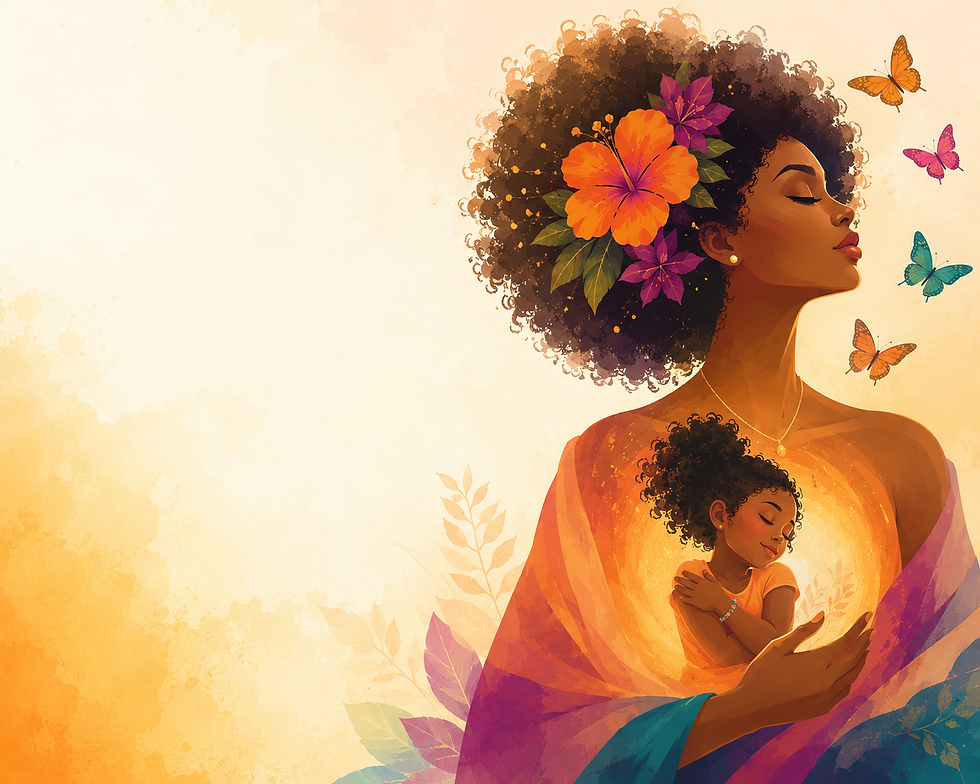
We have been in this together all month.
We began under the same sun — with the recognition that the stories we carry about family, about the people who first held us or failed to, do not stay private. They shape us. They travel with us. They show up in our bodies, our relationships, our patterns, and our sense of what we deserve.
We sat with Yellow — with grief that does not resolve cleanly, with the complicated love of daughters who kept showing up even when showing up cost them. With the recognition that the relationship does not end at death. It changes shape.
Now we go deeper. Into the mechanism. Into the why.
If you have been nodding along — if something in this series has been landing in a place that feels both painful and clarifying — this piece is where we name what you have been living. Not just as a personal story. As a pattern. As an inheritance. As something that can be understood, interrupted, and — with intention — changed.
Before we talk about healing, we have to talk about truth.
The Mother Wound is not simply the pain of having a difficult mother.
It is the emotional, psychological, relational, and often bodily imprint left when the person expected to nurture, protect, guide, attune, and emotionally shelter a child is unable — or unwilling — to do so consistently.
It is not only about what happened.
It is also about what never happened.
The comfort that never came.
The protection that was absent.
The apology that was withheld.
The affection that felt conditional.
The child who became useful before they were ever allowed to simply be.
The First Mirror
A mother is often a child's first mirror.
Through her presence — or absence — a child begins to learn:
Am I safe?
Am I wanted?
Am I too much?
Am I enough?
Do I matter?
If the mirror is steady, attuned, and loving, the child internalizes worth.
If the mirror is distorted — by trauma, absence, control, shame, neglect, competition, emotional immaturity, or survival — the child does not question the mirror.
The child questions themselves.
And that is where the wound begins.
Some children become performers.
Some become caretakers.
Some become invisible.
Some become exceptional.
Some become quiet.
Some become pleasing.
Some become difficult because difficult is the only way they can still be seen.
Every adaptation makes sense in the environment that produced it.
A child who learns that love is unpredictable may become an adult who over-explains, over-functions, or over-apologizes. A child who learns that softness is unsafe may become an adult who mistakes emotional armor for strength. A child who learns that their needs are burdensome may become an adult who does not ask for help until collapse is near.
The wound is not always in what happened.
Sometimes it is in what the child concluded about themselves because of what happened.
I am too much.
I am not enough.
I must earn love.
I must stay useful.
I must not need too much.
I must become what keeps me safe.
These conclusions do not begin as conscious thoughts. They begin as adaptations. They become reflexes. Then identities. Then relationship patterns. And unless they are named, questioned, grieved, and interrupted, they can quietly follow a person for decades.
That is why the first mirror matters.
Because long before a child has language, the body is already listening.
Not All Wounds Are the Same
Not every mother wound bleeds the same way.
Some are a bee sting — sharp, painful, but temporary.
Some are a splinter — small, but festering over time if ignored.
Some are a cut — visible, acknowledged, requiring care.
Some are a broken bone — deep, destabilizing, requiring intervention.
And some are internal injuries after impact — unseen, minimized, dismissed… until they become systemic.
The problem is not just the wound.
It is the denial of the wound.
It is being told:
That didn't happen.
It wasn't that bad.
She did the best she could.
You should be grateful.
But healing does not begin with forced gratitude.
Healing begins with truth.
The Mythology of Motherhood
One of the reasons the Mother Wound is so difficult to discuss is because motherhood itself has been mythologized.
Society romanticizes mothers while often silencing children. We are taught that motherhood is inherently nurturing — that giving birth automatically grants emotional wisdom, patience, maturity, and care.
But birth is biological. Mothering is relational.
Nurturing is practiced.
Attunement is learned from the inside-out.
Repair is intentional and vulnerable.
These distinctions matter enormously. Because when we collapse them — when we treat the biological fact of motherhood as proof of the relational capacity — we silence every child whose experience did not match the myth.
And we make healing harder than it needs to be.
Not all Mother Wounds emerge through absence.
Some emerge through competition.
A daughter should never have to compete with her mother for worth, attention, beauty, visibility, achievement, affection, or belonging.
Yet some daughters grow up feeling diminished rather than celebrated.
Their accomplishments become threats.
Their growth becomes evidence of disloyalty.
Their success becomes something to manage rather than rejoice in.
And so they learn to shrink.
To downplay.
To become smaller than they truly are in order to preserve the emotional equilibrium of the relationship.
The Idea of Children vs. The Reality of Children
We often like the idea of babies and children.
We like the sweetness. The photos. The outfits. The tiny shoes. The ability to dress them up, shape them, mold them, and imagine them becoming extensions of who we are — or who we wish we had been.
But babies do not arrive as blank slates for our fantasies.
They come into the world already carrying something sacred and distinct:
Their own soul.
Their own temperament.
Their own sensitivities.
Their own wiring.
Their own blueprint.
They are not here to fold into us. They are not here to become emotional containers for our pain, proof of our worth, or extensions of our identity. They are not here to live confined within containers shaped by our fears, limitations, wounds, expectations, or unhealed narratives.
They are not us. They are them.
And having a child does not make a woman maternal.
Birth is biological.
Mothering is relational.
Nurturing is practiced.
Attunement is learned.
Repair is intentional.
This is one of the quiet ways we fail children. We celebrate their arrival — but dismiss their personhood. We assign value based on obedience, usefulness, personality, similarity, and performance. We call control love. We call fear respect. We call silence good behavior.
And rarely do we ask: What does this do to a child's psyche? What does this teach their nervous system? What version of love are we imprinting? What will they spend adulthood trying to unlearn?
A child may not have the language.
But the body knows.
Wash. Rinse. Repeat.
What is not named becomes normalized.
What is normalized becomes repeated.
What is repeated becomes legacy.
This is how the Mother Wound travels.
Not just through behavior — but through belief. And what becomes legacy often goes unquestioned. Not because the people inside it are indifferent to truth, but because the wound itself becomes the water they swim in. Invisible. Ambient. Simply the way things are.
Until someone decides to look at it directly.
Lou's Story: Survival Without a Blueprint
Lou lost her mother at sixteen.
Her siblings were already adults. Many had migrated west, chasing opportunity and survival. Lou, the youngest, was left in the Jim Crow South without a maternal anchor.
Eventually, she was sent away — put on a bus to California to live with her sisters.
What may have been framed as opportunity was, for Lou, another rupture. Another displacement. Another absence of protection. Another moment where no one asked: What does this child need?
She did not arrive into nurture.
She arrived into expectation.
She became labor.
A built-in babysitter.
A body in the house.
A girl without protection, without guidance, without emotional shelter.
Someone to manage. Another mouth to feed. Someone to control — rather than care for.
Her sisters were not cruel in isolation. The way they related to each other was learned in the environment. The emotional shutdowns. The icy silence when conflict emerged and the continuous inability to reach repair or resolution. These behaviors were learned. Imparted in each one of them.
They were survivors.
Women who had not been mothered often do not know how to mother. How do you learn softness and nurturing when everything around you is harsh? Punitive? Unfair?
Softness can feel unsafe.
Tenderness unfamiliar.
Needs burdensome.
Care conditional.
Then came a man.
Older. Working. With a car. With access. With attention.
For Lou, he was not just a man. He was a way out. And when you are trying to survive, a way out can feel like love. When you are running from cruelty and control, that way out can feel like a savior.
Not love.
Escape.
And this is where the story deepens.
When home is unsafe, attention feels like rescue.
When life is restricted, access feels like freedom.
When love is absent, being chosen feels like salvation.
Marriage became the exit.
Pregnancy followed.
Violence followed.
Leaving followed.
Then another relationship. Another hope. Another man who looked like a prize. Another pregnancy. Another attempt to make something work.
Then came the cheating.
The beatings.
The alcoholism.
The instability.
The emotional erosion.
It was familiar.
And familiarity is often mistaken for fate.
What Lou learned about love, she learned before she had language for it. And it shaped everything that came after.
Transactional Love
Lou — and her sisters — learned something early:
Love is not freely given.
Love is negotiated.
Love is endured.
Love is survived.
In families shaped by unresolved trauma, love can become confused with obligation.
Loyalty replaces intimacy.
Sacrifice replaces reciprocity.
Endurance replaces joy.
Exhaustion becomes evidence of devotion.
The person who gives the most is celebrated. The person who tolerates the most is admired. The person who carries the heaviest burden is viewed as strong.
But strength and self-abandonment are not the same thing.
Many children raised in these systems learn that love must be earned through service. Through usefulness. Through performance. Through being the responsible one, the accommodating one, the fixer, the peacemaker, the achiever, the emotional caretaker.
Their worth becomes tied to what they do rather than who they are.
As adults, they may struggle to distinguish between being loved and being needed.
They may feel uncomfortable receiving care but highly skilled at providing it. They may enter relationships where they are valued for what they contribute rather than for their presence. They may become the person everyone calls in a crisis while quietly carrying crises of their own.
And because these patterns were learned in the context of attachment, they often feel normal.
Familiar.
Even virtuous.
The woman who overgives may call it generosity.
The man who never asks for help may call it independence.
The adult child who continually sacrifices their well-being for others may call it love.
But beneath these patterns is often a deeper question:
If I stop performing, if I stop fixing, if I stop carrying everyone else, will I still be worthy of being loved?
This is one of the most painful inheritances of the Mother Wound.
The belief that love is something to earn rather than something to receive.
And healing begins when we start questioning that belief.
When we begin to understand that healthy love does not require constant proving.
That relationships can include reciprocity.
That care can flow both ways.
That being loved for who you are is very different from being valued for what you provide.
Love becomes labor. Control. Access. Exchange.
Children raised in this system become adults who over give. Who undervalue themselves. Who stay too long. Who accept too little. Who confuse attention with care.
And in adulthood, we often call this love — because it is the only version we have known.
The Children: Casualties of War
Lou's children were not just witnesses.
They were impacted. Their memories were not wiped clean — not like a deleted file, not like a factory-reset phone. They absorbed everything.
Neither father showed up meaningfully.
No consistent financial support.
No emotional presence.
No protection.
"Momma's baby, Papa's maybe" was not just a saying. It was a lived reality. The respective fathers went on living, creating new families as if the ones left behind didn't exist.
And this is where the Mother Wound deepens: when the one who is present cannot provide what is needed. When she herself is void, vacant, confused, discouraged, and disappointed.
We observe strength but we don't acknowledge the suffering. We watch to see if they make it out. We marvel at the ingenuity, the endurance, the survival instinct — as if resilience were a gift rather than a wound dressed for public view. But we quietly breathe a sigh of relief that it's not us, and we move on. Until it's us.
We never stop to name where it comes from. The system that produced the suffering. The cycles it established. The patterns it passed down.
Provision without nurture.
Structure without safety.
Correction without connection.
Presence without protection.
Children need more than survival. They need to be seen. They need delight. They need repair. They need someone to care how life is landing inside of them.
The Daughter Who Keeps Returning
One of the most misunderstood aspects of the Mother Wound is this:
Children rarely stop loving their mothers.
Even when they have every reason to.
Children return.
Again and again.
Not because the wound is small.Not because the harm was insignificant.Not because they are weak.
But because attachment is powerful.
Attachment does not disappear simply because reality becomes painful.
A child is wired to seek proximity to the very person they depend upon for survival.
And that wiring often survives long after childhood ends.
Many adult daughters spend decades returning to relationships that continue to hurt them.
Not because they enjoy suffering.
Because hope is difficult to surrender.
Hope that this conversation will be different.
Hope that this holiday will be different.
Hope that this boundary will finally be respected.
Hope that this time they will be seen.
Hope is often the last thing to die.
Sometimes the deepest grief is not losing the mother.
It is losing the hope that the mother will one day become who you needed her to be.
The Body Remembers
The Mother Wound is not only remembered.
It is stored.
In the nervous system.
In the body.
In reflexes.
In relationship patterns.
The body remembers the silence, the tension, the unpredictability, the emotional absence, the pressure to perform, and the danger of needing.
As adults, this may show up as hypervigilance. People-pleasing. Emotional shutdown. Difficulty receiving love. Attraction to chaos. Distrust of calm.
The adult may ask: "Why do I keep choosing this?" Or: "Why does this keep happening to me?"
But the body is choosing what is familiar.
The body keeps score — even when the mind tries to make peace.
When the Wound Has a Clinical Name
What we have been describing throughout this series is not simply emotional history. It is psychological architecture. And it carries clinical weight.
The patterns shaped by early maternal wounding — the hypervigilance, the difficulty trusting, the nervous system that cannot settle into calm, the deep belief that love must be earned — these are documented outcomes of chronic relational stress in childhood. Researchers call it complex trauma. Clinicians recognize it in anxiety disorders, depression, attachment disruptions, and what the field now increasingly calls Complex PTSD: a constellation of symptoms that emerges not from a single event, but from prolonged, repeated relational harm.
The ACE study — one of the largest public health studies ever conducted — found that adverse childhood experiences, including emotional neglect and household dysfunction, are directly linked to adult mental and physical health outcomes. The Mother Wound lives squarely in this territory.
This is not to say that everyone who has experienced a difficult maternal relationship will receive a clinical diagnosis. Many will not. But it is to say this:
What you have been carrying has a mechanism. It is not a character flaw. It is not ingratitude. It is not oversensitivity.
It is a nervous system shaped by what it had to survive. And nervous systems, when given the right conditions, can learn something new.
We will go deeper into the clinical landscape — the research, the language, the pathways to healing — in the next piece in this series. But for now, know this: what you are living has been studied, named, and understood. And understanding is always the beginning.
The Both/And
Mothers were once daughters.
Lou was once a girl. A grieving girl. A displaced girl. A girl without protection. A girl trying to find her way.
Her story deserves compassion.
But compassion does not erase impact.
Two truths can exist:
She suffered.
And she caused suffering.
She survived.
And her children had to survive her.
This is where many people get stuck — caught between the pull to honor a mother and the need to name the truth of what her wounding cost them. Our culture often offers only two options: demonize or protect. Condemn or excuse.
But healing requires a third path. The both/and. The space where a mother's suffering and her children's suffering can coexist without either canceling the other out.
Truth is not betrayal. Naming harm is not hatred. Acknowledging impact is not ingratitude.
It is simply — necessary.
Grief That Has No Ceremony
There is no funeral for the mother you never had.
No ritual for the absence of nurture. No public acknowledgment of emotional neglect.
Just a quiet knowing:
"I needed something I never received."
So the grief becomes quiet. Private. Absorbed. Carried.
We know how to mourn death.
We do not know how to mourn emotional absence.
There are rituals for burial, flowers for loss, cards for bereavement, casseroles for the grieving. There are words people know how to say when someone has died.
But what do we say to the person grieving a mother who was physically present but emotionally unreachable?
What do we offer the adult child grieving the apology that never came, the tenderness that never arrived, the safety that was never established, the delight that was never expressed?
There is no public language for the grief of repeatedly reaching toward someone who could not meet you.
No socially accepted ritual for surrendering hope.
No ceremony for the day you finally understand that the mother you needed may never arrive.
And yet many people spend decades doing exactly that.
They grieve in silence while still buying cards.
They grieve while answering phone calls.
They grieve while showing up for holidays.
They grieve while protecting the image of the family.
They grieve while everyone else tells them to be grateful.
This grief is complicated because it does not always mean the absence of love. Sometimes love was there, but it was tangled with harm. Sometimes there were moments of tenderness surrounded by long seasons of emotional drought. Sometimes the mother who wounded you also fed you, prayed for you, worked hard, survived impossible things, or had moments of beauty.
And still, the wound is real.
That is what makes the grief so difficult to explain.
It is not clean.
It does not fit neatly into resentment or devotion.
It is love and anger.
Longing and clarity.
Compassion and self-protection.
Memory and truth.
And for many, healing begins when they stop asking their grief to be simple.
There is no choo-choo train for children who were emotionally abandoned by a living mother. No sympathy card for the adult who sat across from an empty well for decades, still hoping. No ceremony for the hope that died when the door closed permanently.
But the grief is real. And it deserves to be named — not as complaint, not as accusation, but as honest reckoning with what was lost.
The Inheritance
"I got it from my momma" means more than we think.
I got my survival mode from my momma.
I got my silence from my momma.
I got my distrust from my momma.
I got my endurance from my momma.
I got my emotional armor from my momma.
I got my hypervigilance from my momma.
I got my over-functioning from my momma.
I got my fear of rest from my momma.
I got my... [Fill in the blank] from my momma....
And here is the full truth of that inheritance: some of it kept you alive. Some of it carried you through circumstances that required more than any child should have had to bear. The armor was not a mistake. The endurance was not a character flaw. The vigilance was intelligence in the service of survival.
Honor that.
And then ask: does it still serve you now?
What Healing Is Not
Healing is not pretending it did not happen.
Healing is not forcing yourself into gratitude before you have told the truth.
Healing is not rushing to forgiveness because other people are uncomfortable with your pain.
Healing is not reconciling at any cost.
Healing is not abandoning yourself to preserve someone else’s image.
Healing is not protecting the family story while your nervous system carries the family wound.
Healing is not silence.
It is not performance.
It is not spiritual bypassing.
It is not calling harm “love” because the person who harmed you was also hurting.
Healing may include compassion, but compassion is not denial.
Healing may include forgiveness, but forgiveness is not amnesia.
Healing may include understanding, but understanding is not permission for continued harm.
Healing may include relationship, but relationship without accountability is not repair.
Sometimes healing means staying.
Sometimes healing means leaving.
Sometimes healing means limited contact.
Sometimes healing means no contact.
Sometimes healing means telling the truth only to yourself first, because that is the safest place to begin.
Healing is not one single decision. It is a practice.
A returning.
A remembering.
A refusal to keep betraying yourself in order to belong to systems that required your silence.
Healing is remembering differently.
It is looking back with more language, more compassion, more clarity, and more protection for the child you were.
It is learning to say:
That hurt me.
That shaped me.
That was not mine to carry.
That pattern ends with me.
Healing is not becoming hard.
It is becoming discerning.
The Moment of Choosing
There is a moment — and you cannot manufacture it or rush it or arrive at it by sheer determination — when the inheritance becomes visible. When you recognize the pattern clearly enough to name it. When you realize you are standing at a threshold.
On one side: the familiar. The known. The relational templates laid down before you had language to question them. The survival strategies that have been running quietly in the background of your life, shaping your choices without your full awareness.
On the other side: something different. Something you will have to build rather than inherit. Something that requires you to grieve what you did not receive, to honor what helped you survive it, and to step deliberately into a way of being that was never modeled for you.
That threshold is not crossed easily. But it is crossed. Every day, by people who decided — imperfectly, non-linearly, with enormous patience and occasional stumbling — that the pattern ends here.
Not because their mother was a villain.
Not because the story was simple.
But because they finally understood: the inheritance is not the destiny.
Awareness is the interruption.
The Choice
Healing the Mother Wound is not about blame.
It is about truth.
It is not about diminishing others. It is about naming what is true for you. You can love and still name your pain. Your wound. Your suffering.
It is about asking:
What did I inherit?
What did I normalize?
What am I still trying to earn?
What will I no longer carry?
And that choice — right there — is where healing begins.
Reclaiming the Mother Within
At some point, we become the one we needed.
The one who does not abandon. Who does not silence. Who does not make love a performance or a debt. Who learns — slowly, imperfectly, and with enormous patience — to receive as well as to give.
Healing may look like setting a boundary and keeping it. It may look like grieving what was absent rather than pretending it was not. It may look like choosing differently in a moment when the old pattern would have chosen for you. It may look like requiring reciprocity — not as an ultimatum, but as a standard. Like ending what cannot be repaired and beginning what can.
It does not look the same for everyone. But it always begins in the same place.
With the decision to become safe for yourself.
Closing
You may have inherited the wound.
But you are not required to pass it on.
And in choosing differently — you become the interruption. You disrupt the dysfunctional patterns passed down. The patterns that no longer serve you. The cycles that repeat with no benefit. You become the one who is aware and declares: no more.
The cycle does not end loudly. It ends in the quiet, consistent, daily practice of choosing yourself. Of tending to the child you were with the care she deserved. Of building, from the inside out, the safety that was never consistently provided from the outside in.
That is the inheritance worth passing on.
Not the wound.
Not the silence.
Not the survival strategy.
But the awareness.
The interruption.
The courage to tell the truth.
The willingness to love differently.
The decision to become what you needed.
And perhaps that is the most profound act of mothering there is.
Affirmation
I honor what shaped me — without allowing it to define me.
I am allowed to tell the truth about what I experienced.
I am allowed to grieve what I did not receive.
I am allowed to release what was never mine to carry.
I am not too much.
I am not too sensitive.
I am not the problem that needed fixing.
I am a person who adapted.
I am a person who survived.
I am a person who is now choosing differently.
I can learn a new way to love.
I can learn a new way to receive.
I can become safe for myself.
What I inherited ends where I decide it ends.
I am not just the product of my past.
I am the author of what comes next.
✏ Reflection & Journal Prompts
Use these slowly. This is deep work. One prompt is enough.
🌿 Truth-Telling
What did I need from my mother that I learned to live without?
What did I normalize that, in truth, hurt me?
🌿 Awareness of Inheritance
In what ways do I see my mother's patterns showing up in me?
Which of these patterns feel aligned — and which feel like they need to end?
🌿 Emotional Clarity
What feelings come up when I think about my mother: anger, grief, confusion, longing, numbness?
Which emotions have I not allowed myself to fully feel?
🌿 Relationship Patterns
Where in my life am I still trying to earn love, approval, or safety?
What do I currently tolerate that mirrors what I once had to survive?
🌿 Reclaiming Self
What would it look like to stop abandoning myself in relationships?
What does "mothering myself" actually look like in my daily life?
🌿 Boundaries & Choice
Where do I need to set or strengthen a boundary — without guilt or explanation?
What am I no longer willing to carry forward?
🌿 Rewriting the Narrative
If I were not defined by what I experienced, who would I allow myself to become?
What does a new blueprint for love, safety, and care look like for me?
🌿 The Daughter Within
What part of me is still waiting for something from my mother?
What would it mean to lovingly release that waiting?
A Blessing for the Wounded and Becoming Heart
May you have the courage to tell the truth of your story —
not the version that keeps others comfortable,
but the one that sets you free.
May you release the burden of pretending
that what hurt you did not matter.
May you grieve — fully, honestly, and without shame —
not only who was lost,
but what was never given.
May you come to understand
that your sensitivity was never your weakness —
it was your awareness.
May you forgive yourself
for what you tolerated
before you had the language, the tools, or the choice.
May you learn to recognize love
not by intensity,
not by familiarity,
but by safety, consistency, and care.
May you become the steady presence
you once searched for in others.
May you speak to yourself
with the gentleness you deserved.
May you create space in your life
for relationships that do not require you to shrink, perform, or prove.
May you remember:
You were always worthy.
You were always enough.
You were always deserving of tenderness.
And may what was passed down to you
find its end point — not in silence,
but in your awareness, your choice, and your healing.


Comments