
Sitting in SolitudeThe Gift of Returning to Yourself


The outer world is loud.
It shouts its demands, its seductions, and its standards: go here, do this, buy that, become more, prove yourself, keep up, don't fall behind. It tells us, directly and indirectly, that we only measure up if we achieve enough, acquire enough, impress enough, or perform well enough. It keeps moving the goalpost and then leaves us breathless trying to catch up.
And then there are the opinions.
People will always have something to say about what they think, how things should be, what choices make sense, what path is respectable, what timing is acceptable, what kind of life is realistic, and what kind of success is "too much" for someone like you. They will have comments about what you should do, who you should be, and what you are supposed to have.
But opinion is not prophecy. Commentary is not wisdom.
If people were truly so all-knowing, so discerning, so deeply prophetic in their understanding of life, where is the power to solve hatred, injury, harm, hunger, war, and disease? Where is the certainty that can protect every heart from grief, every life from disappointment, every child from harm? Human beings have insights. We can notice patterns. We can learn from lived experience. We can observe behavior and sometimes make wise conclusions. But none of us is holding a magic wand. None of us sees the whole picture.
And that is why solitude matters.
The Invitation of Stillness
Sitting in solitude is one of the simplest and most radical ways we return to ourselves. It is one of the ways we quiet the external noise long enough to hear the inner voice. It is how we begin to sort wisdom from noise, discernment from projection, and truth from pressure.
This does not mean we reject all guidance. It is important to notice patterns. It is important to learn from the lived experiences of others. Our circumstances are not always as unique as we imagine. Human beings can be painfully predictable. And yet there are also surprises — redemption, change, people who break the mold and choose differently. We can learn from patterns without becoming imprisoned by them. We can honor wisdom from others without surrendering our own inner authority.
Still, all of that points us back to the same essential task: learning to face ourselves honestly.
To know our strengths and our weaknesses.
To recognize our public-facing selves and our shadows.
To notice where we are clear and where we are confused.
To tell ourselves the truth without shaming ourselves for being human.
To build self-trust.
That is no small task.
Why Stillness Is Not Easy
For many people, solitude is difficult not because it is empty, but because it is revealing. Silence removes the buffer between us and what hurts.
When the noise dies down, we may come face to face with disappointment, grief, regret, shame, envy, loneliness, exhaustion, or the ache of unmet needs. We may finally feel the weight of what we have been too busy to feel. We may come to the edge of something we have been outrunning for months, sometimes years.
This is why some people avoid stillness. Not because they are shallow. Not because they are weak. But because stillness has a way of uncovering what has been buried beneath busyness, striving, over-functioning, and distraction.
Solitude is not always immediately peaceful.
Sometimes it is sobering.
Sometimes it is unsettling.
Sometimes it is where the tears come.
Sometimes it is where the body finally tells the truth.
What the Body Knows
Because the body knows.
Not everything that qualifies as inner guidance arrives as a sentence. Sometimes it is a sensation. A heaviness in the gut. A tightening in the chest. A fatigue that follows certain spaces, people, or choices. A quiet dread around something that looks good on paper but does not feel right in the spirit. A softening when something is true. A sense of relief when we stop performing and finally admit what we know.
The body often speaks long before the mind is ready to listen. It carries what we have minimized, postponed, or rationalized. It holds the grief we never had time for and the longing we were too afraid to name. In solitude, without the static of the outer world, the body finally gets to be heard.
That is why sitting in solitude can become a sacred practice of listening.
Not listening for perfection.
Not listening for a dramatic answer.
Not listening for the kind of certainty that erases all risk.
But listening for the still small voice.
The whisper.
The nudge.
The gentle but steady truth.
Wisdom rarely needs to shout. Intuition does not usually bully. Inner guidance often comes quietly — in whispers, not commands. In pauses, not pressure. In invitations, not spectacle.
The outer world shouts. Inner wisdom whispers. And if we are constantly overstimulated, overcommitted, and overrun by the demands and opinions of others, we may lose our capacity to hear ourselves at all.
The Cost of Self-Abandonment
That loss is costly.
Some of us are weary not just from living, but from chasing lives, standards, relationships, opportunities, and outcomes that were never truly ours. We are tired from abandoning ourselves to keep pace with expectations we did not create. We are tired from overriding our own signals in order to be liked, chosen, validated, approved of, or taken seriously. We are tired from trying to earn worth in systems that were never designed to affirm our full humanity.
When we keep living by the noise, we do not just exhaust ourselves. We abandon ourselves. We betray our own inner signals. We silence the very voice that could lead us home. And we build lives that look correct from the outside while feeling hollow at the center.
That is the cost of self-abandonment. And it is a cost that compounds quietly, day by day, choice by choice, until the body sounds the alarm we can no longer ignore.
That cost is especially high for those who come from little.
Especially for the underdog.
Especially for the overlooked.
Especially for those born into the strangulating conditions of
oppression, neglect, dismissal, invisibility, poverty, or emotional deprivation.
Especially for those who were not expected to rise.
When you come from nothing, self-trust is not a luxury. It is a lifeline.
When the world has already decided who you are supposed to be, how far you are allowed to go, what kind of love or ease or beauty or success is "appropriate" for you, you cannot afford to build your life around other people's small imagination. You cannot make a home inside the limits others have imagined for you.
Others may bet against you.
They may fail to see your shine.
They may try to dim your light.
They may dismiss your dreams, not because your dreams are impossible,
but because your becoming unsettles their sense of what is possible.
And here is what is also true: not every voice around you is invested in your becoming. Some voices benefit from your doubt. Some people have quietly assigned you a ceiling — decided how visible you should be, how powerful you should become, how much joy or tenderness or abundance belongs to someone like you.
Do not confuse their limits with your truth.
When the world has no vision for your becoming, you must learn to see for yourself. And sometimes the only place you can recover that vision is in solitude.
Solitude Is Not Isolation
Not isolation.
Not shutting down.
Not disappearing.
Not punishment.
Solitude.
There is a difference.
Isolation is often shaped by despair, fear, disconnection, or defense. It is the pulling away that happens when we feel unseen, overwhelmed, or unworthy of connection. Isolation shrinks us. It feeds shame. It keeps us orbiting our wounds without ever finding rest.
Solitude, when chosen with intention, is something else entirely. It becomes sanctuary. A place of recalibration. A place where the nervous system can settle. A place where performance can soften. A place where we can stop trying to be readable, acceptable, and impressive long enough to become honest.
Solitude is not abandoning yourself. It is returning to yourself.
And self-compassion is what makes that return healing.
Because the point is not simply to sit in quiet. The point is to sit in quiet without attacking yourself there. To meet what rises with tenderness instead of contempt. To notice what hurts without turning it into evidence of failure. To allow grief, confusion, disappointment, or longing to have a seat without letting shame take over the room.
You do not have to solve your whole life in one sitting.
Sometimes the gift of solitude is simply this: telling yourself the truth without abandoning yourself in the process.
Where Self-Trust Begins
Perhaps that is where self-trust begins.
Not in having every answer.
Not in being fearless.
Not in never making mistakes.
But in learning that you can sit with yourself honestly.
That you can hear something difficult and stay.
That you can notice what needs tending and respond with care.
That you can listen inward and not run.
That you can face what is true and still be kind to yourself.
That is sacred work.
In a world that constantly pressures us to perform, compare, consume, and conform, sitting in solitude becomes an act of resistance. It is a refusal to let every external voice define your value, your pace, your path, or your possibilities. It is a way of reclaiming inner authority. It is how we begin to hear what is ours and release what is not.
The Invitation
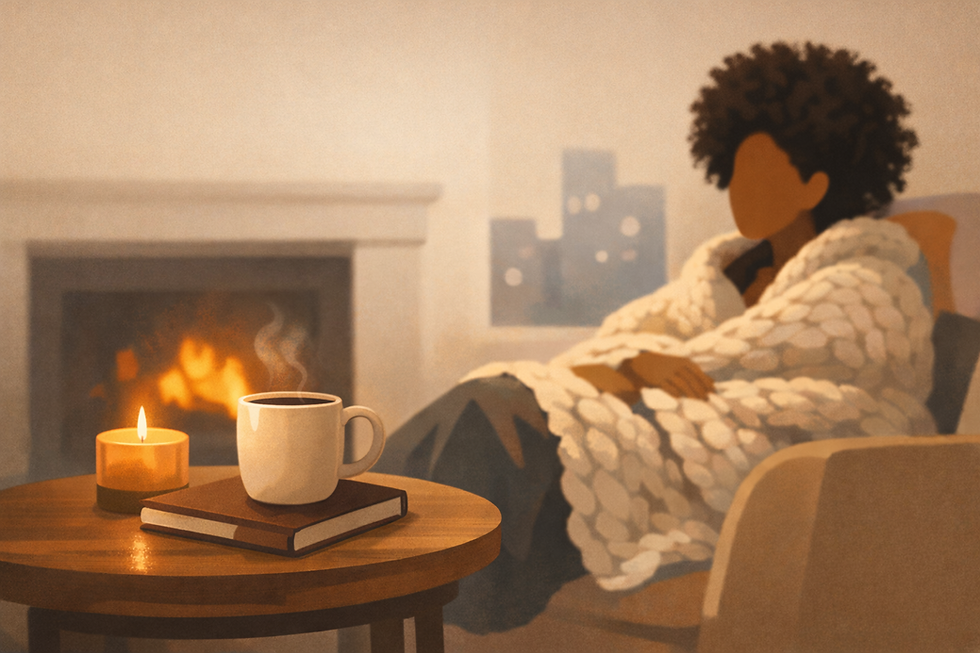
So sit for a while.
Sit without fixing.
Sit without proving.
Sit without rehearsing your defense.
Sit without trying to become more palatable, more impressive, more explainable.
Sit long enough to hear what your body knows.
Sit long enough to notice what your spirit is trying to say.
Sit long enough to remember that not every loud voice is a wise voice.
Sit long enough to come back into your own presence.
The quiet may not give you every answer. It may not erase grief. It may not resolve uncertainty overnight. It may not remove the risks that come with becoming.
But it can return you to your center.
And from there, you may choose more honestly.
You may love more wisely.
You may stop chasing what was never yours.
You may stop outsourcing your worth.
You may remember what has always been there beneath the noise:
your knowing,
your dignity,
your breath,
your light,
your inner compass,
your capacity to begin again.
Sometimes the only way out is in.
Sometimes the only way up is within.
— ✦ —
Affirmations for the Quiet Moments
Speak these gently. Return to them often.
I trust myself to hear what is true.
My stillness is not emptiness — it is presence.
I am allowed to slow down without losing ground.
I do not have to earn my rest.
The quiet is not a threat. It is an invitation.
I choose to return to myself, again and again.
My inner compass is reliable. I choose to follow it.
I can hold what hurts without letting shame define it.
I was not made to chase what does not belong to me.
I am worthy of the life that is quietly calling me forward.
— ✦ —
A Simple Practice: Coming Home to Yourself
You do not need an hour. You do not need a perfect space. You need five minutes, a breath, and the willingness to be honest with yourself.
Find a quiet place. Sit comfortably. Place one hand over your heart.
Take three slow breaths — in through the nose, out through the mouth. With each exhale, let the noise of the day move a little further away.
Then ask yourself, gently:
● What am I carrying right now that I have not had space to feel?
● What is my body trying to tell me that my mind has been dismissing?
● What am I chasing that may not truly belong to me?
● Where have I been abandoning myself in order to be accepted?
● What do I know, quietly, beneath all the noise?
You do not need to answer every question fully. Sometimes simply sitting with the question is the beginning of the answer.
When you are ready, take one more breath. Place both hands in your lap. And before you return to the day, offer yourself this simple acknowledgment:
I showed up for myself today. That is enough.
— ✦ —
Journal Prompts for Deeper Reflection
Set aside time, a quiet space, and something to write with. Let these prompts open the door.
● When did I last feel truly at home in myself? What was present in that moment that is absent now?
● What voices (external or internalized) have I been mistaking for my own truth? What might I believe about myself if I set those voices down?
● Where have I been chasing approval, validation, or worth in places that cannot truly give it to me? What has that cost me?
● What has my body been trying to tell me that I have been too busy, too afraid, or too numb to hear?
● What grief, disappointment, or longing lives in me that has not yet had the space to be witnessed — even by myself?
● If I truly trusted my inner compass, what would I do differently? What would I stop? What would I finally begin?
● What does rest, not productivity, actually feel like in my body? When did I last allow it without guilt?
● Who am I when no one is watching, when I do not have to perform or prove anything? What does that version of me need most right now?
There are no correct answers. There is only what is true for you, today, in this season of your becoming.
Return to these questions often. What you find will change as you do.
— ✦ —
You came here. You sat with yourself. That is the beginning.
— ✦ —
A Closing Blessing
May you find peace and wisdom in the quiet.
May the silence not frighten you, but hold you.
May you learn to trust what rises when the noise falls away.
May the voice within guide you in love —
not in urgency, not in self-reproach,
but in the gentle and steady tone
of something that has always known you
and has never stopped believing in your becoming.
May you return to yourself in every act of solitude.
May each quiet moment be a homecoming.
May you find, again and again,
that you are still here —
beneath the striving, beneath the noise,
beneath every version of yourself
you have performed for the world.
May you make space for the inner world
that is calling you to feel, to see, to hear, to be and to know.
May you honor what your body carries.
May you tend to what your spirit grieves.
May you listen for what your soul has long been whispering
beneath the weight of everything you have been too busy to hear.
May you be gentle with yourself in the unfolding.
May you release what was never yours to carry.
May you find the courage to want what you truly want
and the wisdom to wait for what is truly yours.
And may you know, in the deepest and most unshakeable way,
that the act of returning to yourself
is not small.
It is not indulgent.
It is not weakness.
It is one of the most courageous things
a human being can do.
Go gently.
Go honestly.
Go within.


Comments